How to Price Wedding Videography When You Work on Day Rates
Why a wedding is not one shoot day, how to count the hours a wedding film actually takes, and how to turn your day rate into a package price you can defend.
By The Rate Guide StaffRates11 min readUpdated Oct 20265 sources
In this article · 16 sections
- What couples pay
- A wedding is several days of work
- Convert your day rate into a package price
- When the number is higher than the market
- Sell defined packages
- Charge for the Saturday
- Deposits and payment timing
- Overtime on the day
- Second shooters are crew
- Music has to be licensed
- Decide what happens to the footage
- Write delivery dates into the contract
- Smaller costs that add up
- When a couple pushes back
- Before sending the quote
- A wedding is a small production
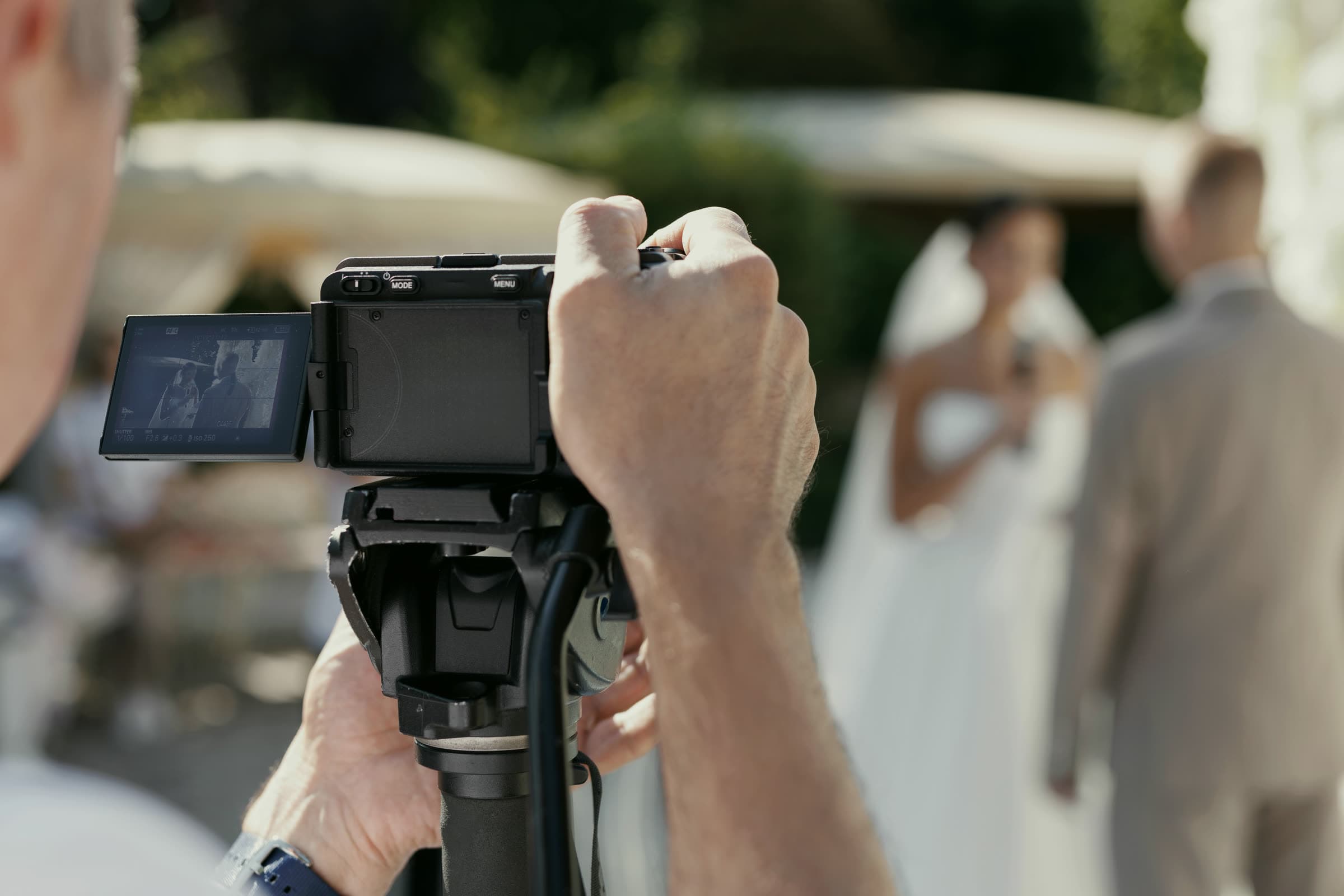
A couple asks what you charge to film their wedding. You work on commercial and corporate sets for a day rate, the wedding is one Saturday, so you quote roughly one day.
You would be charging for the Saturday and giving away the week of work that comes after it.
Weddings are sold as packages, not days. The couple is buying a finished film, and most of that film gets made after the reception ends: offloading, syncing, logging, cutting, music, color, sound, revisions and delivery. A day-rate freelancer is used to someone else paying for that work, whether it's an editor, a post house or a producer's budget line. At a wedding, that someone is you.
This guide shows how to count that work, price it from the rate you already know, and decide what to do when the number comes out higher than the local market.
What couples pay
The Knot's 2025 Real Weddings Study puts the average US wedding videographer at about $2,300, with lower-budget couples paying around $1,000 and upper-budget couples around $3,300. The Knot
Those figures are a reference point, not a target. They mix solo shooters delivering a three-minute highlight with two-camera teams delivering a full documentary edit. They mix first-year operators with established studios. And they say nothing about how many hours each of those vendors worked to get paid.
Use the market figure to understand what couples expect to spend. Use your own hours to know what you can afford to accept.
A wedding is several days of work
Here is a realistic accounting for one lead shooter delivering a highlight film and a full ceremony edit with eight hours of coverage.
| Work | Hours |
|---|---|
| Inquiry, call, proposal and contract | 2 |
| Timeline planning and venue questions | 2 |
| Gear prep, charging, media and packing | 2 |
| Travel, round trip | 2 |
| Coverage, including arrival and setup | 9 |
| Offload, verify and back up | 2 |
| Sync, log and select | 6 |
| Highlight film edit, music, color, sound | 18 |
| Ceremony edit | 4 |
| Revisions | 3 |
| Export, delivery and client email | 2 |
| Total | 52 |
Your numbers will differ. A documentary edit adds days. A highly stylized highlight may take far longer than eighteen hours, and a fast editor with templates may take less. An editing service that has cut more than 800 weddings puts a highlight film at about 15 hours and a ceremony edit at about
- A Los Angeles studio that cuts longer cinematic films reports 40 to 80 hours
at the desk for each one. WedWill ConneryFilm
Whatever your own figures turn out to be, coverage is about a sixth of the job. A quote built on coverage alone pays for about a sixth of your time.
Track your hours on the next two or three weddings, every task, including email. Replace the estimates in this table with what you spent.
Convert your day rate into a package price
Start with the day rate that covers your costs and your take-home goal. If you haven't worked it out, the day-rate calculator builds it from your expenses, taxes and realistic billable days.
Then convert hours to days. If your rate assumes a 10-hour day, 52 hours is a little over five days of work.
Suppose your calculated rate is $500 a day. That number is a placeholder for the example, not a recommendation:
| Line | Amount |
|---|---|
| Lead shooter and editor, 52 hours at $50/hour | $2,600 |
| Second shooter, coverage day | $400 |
| Equipment package | $250 |
| Music license | $50 |
| Delivery, storage and hosting | $50 |
| Package price | $3,350 |
That lands above the national average and near the upper-budget figure. That is normal. The average includes vendors who undercount their hours, and many of them stop filming weddings after a season or two because the work doesn't pay.
If you would never take a commercial job for $1,500 that kept you busy for five days, don't take a wedding on those terms either.
When the number is higher than the market
You have three honest options, and one dishonest one.
Raise the price. Show work that justifies it and sell to couples whose budget fits. Couples who spend more on a film usually care about the result more, which makes the job easier.
Cut the hours. Change the product rather than the rate. Sell a shorter highlight, a simple ceremony edit with no highlight, fewer coverage hours or no second shooter. Build templates for titles, export settings and color.
Choose not to do weddings. A wedding blocks a Saturday you may otherwise fill with paid commercial work, and it takes most of the following week. If the market won't pay for that, weddings may be a bad use of your time.
The dishonest option is to keep the price and lower the hourly rate you pay yourself without admitting it. That is how a $500-a-day freelancer ends up earning $25 an hour on weekends.
Sell defined packages
Wedding clients are not buying crew time, and line-item quotes confuse them. They need to compare what they get.
Build two or three packages around deliverables:
- Ceremony: ceremony and speeches coverage, edited ceremony, no highlight
- Highlight: eight hours of coverage, highlight film, ceremony edit
- Full day: ten hours, two shooters, highlight film, documentary edit, speeches and dances
Price each one from its own hours. A package without a highlight film saves you most of the editing, so price it well below the highlight package.
Then list additions with their own prices:
- Extra coverage hour
- Second shooter
- Rehearsal dinner coverage
- Social media cut
- Drone coverage, where it's legal and the operator is certified
- Raw footage delivery
- Rush delivery
Every package should say exactly what it includes, how long each film runs and when it will be delivered. A vague package invites the couple to assume it includes everything.
Charge for the Saturday
You can only shoot one wedding on a given Saturday, and there are a limited number of good Saturdays in peak season. A June Saturday is scarcer than a November Thursday.
Many wedding vendors charge more for peak-season Saturdays and offer lower prices for weekdays, Sundays and off-season dates. Do that openly, with a published difference, rather than haggling date by date.
Booking a date also locks out other work. Couples often book a year ahead, and a cancellation six weeks out may leave you no time to fill the date. Your deposit and cancellation terms need to account for that.
Deposits and payment timing
Take a non-refundable retainer when the contract is signed. It holds the date and compensates you if the couple cancels after you've turned away other work.
A common structure:
- Retainer at signing, often 25 to 50 percent
- Remaining balance due before the wedding or at a set date before it
- Additions billed when they are added
Collect the balance before the wedding, not on delivery. Once the day is over, your bargaining position is a hard drive full of footage the couple wants, and holding it hostage is a miserable way to get paid.
Deposits, cancellations and late payments covers retainers, refund terms and what to do when a balance is late.
Overtime on the day
Receptions run long. The DJ extends the dance floor, the toasts start late, the sparkler exit moves back an hour.
Decide your overtime terms before the wedding:
- Hourly overtime rate for each shooter
- Who can approve it on the day, usually one of the couple or the planner
- How it gets billed, usually on the final invoice or with the delivery
- Whether you will leave at the contracted end time if nobody approves it
An extra hour of reception coverage also means another hour of footage to log and cut, so set the overtime rate to cover both.
Second shooters are crew
If you hire a second shooter, you are now the production. Pay them at least a fair day rate for the coverage, and decide in advance whether they bring their own camera. The camera operator day-rate guide covers what operators charge on other jobs.
Put the arrangement in writing: call time, end time, overtime, gear, footage handoff, whether they can post clips for their own portfolio, and when they get paid. Don't make their payment wait for the couple's.
Music has to be licensed
The venue's music license lets the DJ play the couple's first-dance song at the reception. Cutting a highlight film to that song needs a separate sync license. Post that film with an unlicensed commercial track and it can be matched on upload: YouTube's Content ID lets the rights holder block the video or take its ad revenue. YouTube Help The couple sees a blocked film. Your name is on it.
Use a library license that covers the use you need, and read the terms. Some licenses cover delivery to one couple but not your own marketing. Musicbed's single-song wedding license, for example, does not cover promoting your videography business. Musicbed
Build the license cost into the package, and keep a record of which track was licensed for which film.
Ambient audio of the first dance, recorded as it happened, is part of the documentary record. A highlight film cut to that song is a different use. If a couple insists on a specific commercial song, explain the risk in plain terms and keep that edit private or unpublished.
Decide what happens to the footage
Couples sometimes ask for the raw footage. Decide in advance whether you offer it, at what price, and in what form.
Raw footage takes time to organize and storage to deliver. It also lets someone else cut a different film from your work. Many wedding filmmakers sell it as a paid add-on or don't offer it at all. Either is fine if the contract says so.
Also state:
- How long you keep the footage after delivery
- How the films will be delivered and for how long the link stays active
- Whether you can use the film and stills in your portfolio
- How the couple can opt out of portfolio use
Some couples don't want their wedding online. Ask, and respect the answer. A film you can't show still has to earn its price.
Write delivery dates into the contract
The most common complaint about wedding videographers is waiting. Set a delivery window for each film, not a vague promise.
Highlight film delivered within 8 weeks of the wedding date.
Ceremony edit delivered within 10 weeks.
One round of revisions, requested within 14 days of delivery.
Revisions should be defined: music changes, trimming a moment, fixing a name. A request to rebuild the film around a different structure is a new edit, and it should cost money.
If you offer rush delivery, charge for it. Rush means another client waits or you work nights.
A wedding contract should cover the date, coverage hours, deliverables, payment schedule, cancellation, overtime, travel, meals, footage retention, portfolio use, music, revisions and what happens if you are sick or your equipment fails. The Contract Pack includes production contract templates you can adapt. Have the final version reviewed for your state.
Smaller costs that add up
Check each package for:
- Meals: a long wedding with no vendor meal is a long day; ask for one in the contract
- Travel beyond a set radius, by mile or flat fee
- Lodging when the venue is far away or the day runs late
- Parking and venue vendor fees
- Media, drives and backup storage
- Hosting or delivery platform
- Payment processing fees
- Liability insurance; many venues require a certificate
- Equipment wear and replacement
The kit fee article explains how to work out what your equipment costs to own. On a wedding quote, you don't need to show the couple a separate gear line, but the package price has to cover it.
When a couple pushes back
"The other videographer is $1,500."
"Their package may include different coverage or a shorter film. Here's exactly what's in ours. If budget is the issue, the ceremony package might be a better fit."
"It's only one day. Why does it cost this much?"
"The wedding is one day of filming. Editing the film is most of the work, usually another four or five days after the wedding."
"Can you just send us all the footage instead of editing?"
"I can, as a raw footage package. It still takes time to organize and deliver, so it's priced separately."
"Can you stay another hour?"
"Sure. Overtime is $150 an hour for both of us. Who should approve it?"
Give couples smaller packages instead of discounts. Changing the product keeps the price meaningful. Lowering the price for the same product teaches couples that your first quote was padded.
Before sending the quote
Confirm:
- The package names coverage hours, number of shooters and each deliverable
- Each film has a running time and a delivery window
- The price covers editing hours, not just coverage hours
- Peak and off-peak pricing is stated
- Retainer, balance due date and cancellation terms are in the contract
- Overtime has a rate and an approval rule
- Travel, lodging and meals are addressed
- Music is licensed for the uses you plan
- Raw footage, retention and portfolio use are covered
- Second shooters are booked and their pay is settled
Then compare the package price to your total hours. If the hourly figure is below what you'd accept on any other job, change the package or the price before you send it.
A wedding is a small production
You are the producer, director, camera team, editor, colorist, sound mixer and delivery department, and you are doing it for a client who has never hired crew before.
Price it like a production. Count the post. Charge for the Saturday. Get paid before the day. Put the delivery dates in writing.
If the price covers the post, a wedding is good work for a free Saturday. If it covers only the coverage, you are working the following week for free.